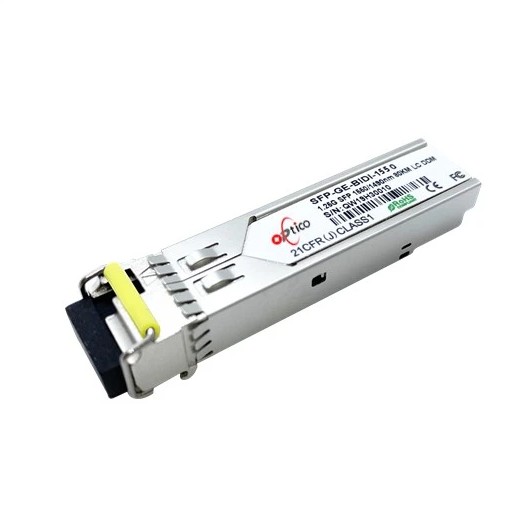
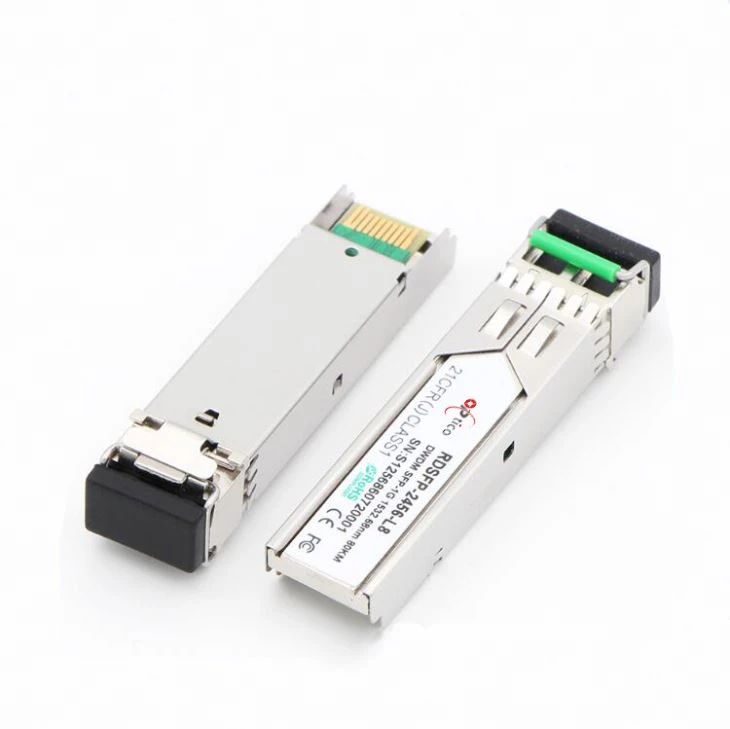
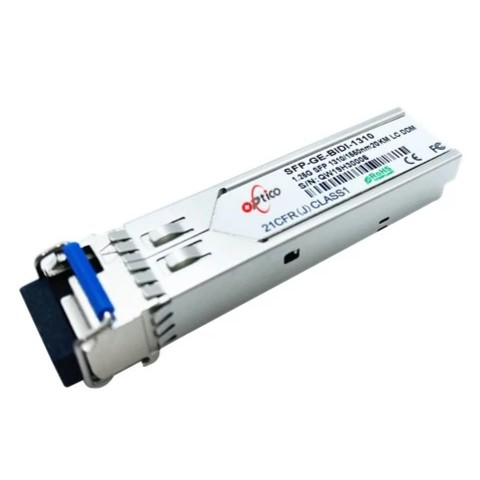
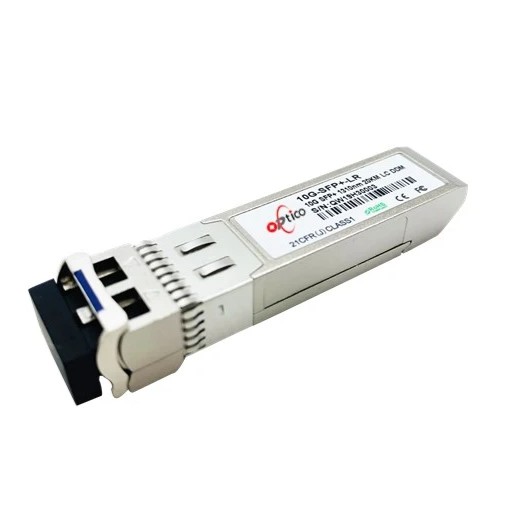
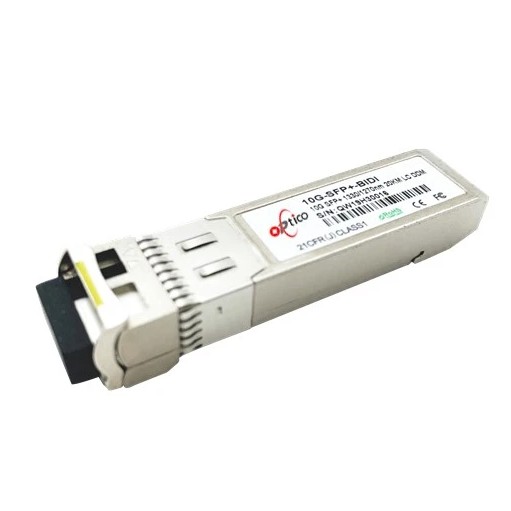
The SFP optical module is a hot-swappable small package module in an SFP package. The SFP optical module is
mainly composed of a laser. SFP classification can be divided into rate classification, wavelength
classification, and pattern classification.
SFP is an abbreviation of SMALL FORM PLUGGABLE, which can be easily understood as an upgraded version of GBIC.
SFP module
The volume is half the size of the GBIC module, only the size of the thumb. You can configure more than double
the number of ports on the same panel. The other functions of the SFP module are basically the same as the GBIC.
Some switch manufacturers call the SFP module a miniaturized GBIC (MINI-GBIC)
1.25G 40KM SFP Transceiver Features:
- SFP package with SC connector
- 1310nm FP Laser and 1550nm PIN photodetector
- 1550nm DFB Laser and 1310nm PIN photodetector
- Up to 40Km transmission on SMF
- +3.3V single power supply
- LVPECL compatible data input/output interface
- Low EMI and excellent ESD protection
- Laser safety standard IEC-60825 compliant
- Compatible with RoHS
- Compatible with SFF8472
- (Ambient Operating Temperature 0°C to +70°C, Vcc =3.3 V)
| Parameter |
Symbol |
Min. |
Typ. |
Max. |
Units |
| Transmitter Section |
|
|
|
|
|
| Center Wavelength |
Tx 1310
lo |
1260 |
1310 |
1360 |
nm |
| Center Wavelength |
Tx 1550 |
1540 |
1550 |
1560 |
nm |
| Spectral Width(RMS) |
Tx 1310
Dl |
- |
- |
4 |
nm |
| Spectral Width(RMS) |
Tx 1550 |
|
1 |
|
|
| Average Output Power |
Tx 1310
Po |
-5 |
- |
0 |
dBm |
| Average Output Power |
Tx 1550 |
-5 |
|
0 |
dBm |
| Extinction Ratio |
Er |
10 |
- |
15 |
dB |
| Rise/Fall Time(20%~80%) |
Tr/Tf |
|
0.26 |
|
ns |
| Total jitter |
Tj |
|
0.43 |
|
UI |
| Optical Eye Diagram |
|
|
IEEE 802.3z and ANSI Fibre Channel Compatible |
|
|
| Receiver Section |
|
|
|
|
|
| Center Wavelength |
Rx 1550
lo |
1500 |
1550 |
1600 |
nm |
| Center Wavelength |
Rx 1310 |
1260 |
1310 |
1360 |
nm |
| Receiver Sensitivity |
Rsen |
|
-24 |
|
dBm |
| Receiver Overload |
Rov |
-3 |
|
|
dBm |
| Return Loss |
|
12 |
|
|
dB |
| LOS Assert |
LOSA |
-36 |
|
|
dBm |
| LOS Dessert |
LOSD |
|
|
-24 |
dBm |
| LOS Hysteresis |
|
0.5 |
|
5 |
|
SFP Classification:
Classification By Rate:
According to the rate, there are 155M/622M/1.25G/2.125G/4.25G/8G/10G, 155M and 1.25G are used in the market. The
10G technology is gradually maturing, and the demand is developing in an upward trend.
Classification By Wavelength:
According to the wavelength, there are850nm/1310nm/1550nm/1490nm/1530nm/1610nm, the wavelength is 850nm for SFP
multimode, the transmission distance is below 2KM, the wavelength is 1310/1550nm for single mode, and the
transmission distance is above 2KM. Relatively speaking, this The price of the three wavelengths is cheaper than
the other three.
If the bare module is not easily confused, the manufacturer will distinguish the color of the pull ring. For
example, the black pull ring is multimode and the wavelength is 850 nm; the blue is the module with the
wavelength of 1310 nm; the yellow is the module with the wavelength of 1550 nm. Purple is a module with a
wavelength of 1490 nm.
Classification By Mode:
Multimode
Almost all multimode fibers are 50/125um or 62.5/125um in size, and the bandwidth (the amount of information
transmitted by the fiber) is typically 200MHz to 2GHz. Multimode optical transceivers can carry up to 5
kilometers of transmission over multimode fiber. A light emitting diode or a laser is used as a light source.
The pull ring or outer body is black in color.
Single mode
Single mode fiber has a size of 9-10/125µm and has an infinite bandwidth and lower loss characteristics than
multimode fiber. Single-mode optical transceivers are often used for long-distance transmission, sometimes
reaching 150 to 200 kilometers. LEDs with narrower LD or spectral lines are used as the light source. The color
of the pull ring or outer body is blue, yellow or purple.